


- WATER & FLOOD
Water Damage on Your Ceiling? Here's Exactly What to Do
Professional Restoration Services Team●Updated June 1, 2026●8 min read
- QUICK SUMMARY
- Act fast. Make the area safe, stop the water source, and start drying immediately — speed is the single biggest factor in your final repair bill.
- Document first. Take timestamped photos and video before you clean up, or you may complicate your insurance claim.
- Look past the stain. Mold can begin within 24–48 hours, and water spreads far beyond the visible mark — only moisture meters and thermal imaging find it all.
- Know when to call. Sagging drywall, an unknown source, mold, or an insurance claim all mean it’s time for a certified restoration company.
You notice a stain spreading across your ceiling. Maybe the drywall is starting to sag, or there’s a slow drip you can’t quite trace. If you’re staring at ceiling water damage and wondering what to do first, you’re not alone — and the steps you take in the next hour matter more than most homeowners realize.
This guide covers the most common causes of water damage on ceilings, what to do immediately, and how to know when it’s time to call a professional water damage restoration company.
01
What Causes Ceiling Water Damage?
Burst or leaking pipes
Roof leaks
Overflowing toilets
HVAC condensation
Slow, hidden drips
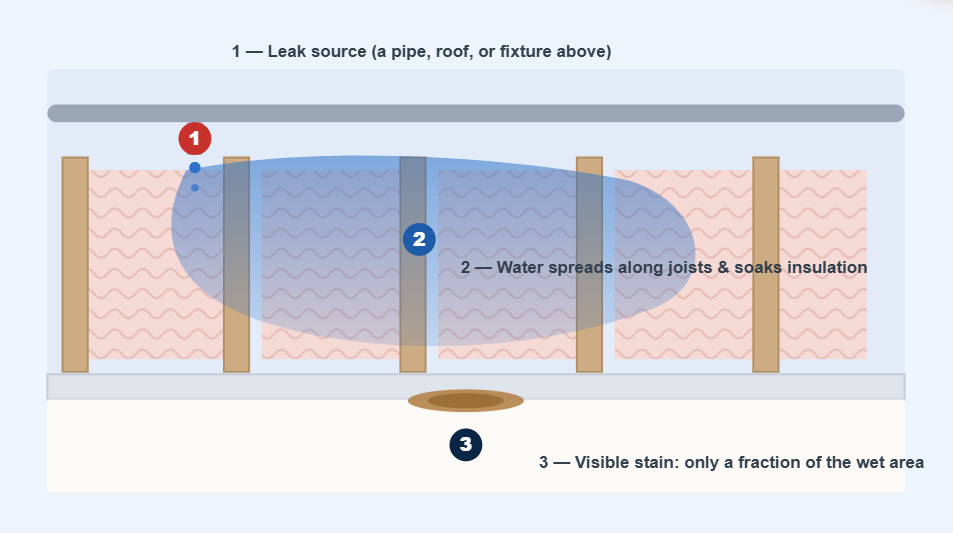
- One important thing to understand: by the time a stain appears or your ceiling starts to sag, water has typically been sitting inside the ceiling cavity far longer than it looks. It travels along joists, soaks into insulation, and spreads well beyond the visible damage zone.
02
What to Do in the First 30 Minutes
Taking action is the single most important thing you can do to limit the total cost of ceiling water damage repair. Here’s what to prioritize right away.
1
Make sure the area is safe
- Stand to the side, never directly underneath a bulging ceiling.
2
Stop the water source
3
Protect your belongings
4
Document everything before you clean up
03
The Hidden Risk Most Homeowners Miss
Here is where ceiling water damage gets more serious that it first appears. A stain on your ceiling is visible. What you cannot see is how far the water actually traveled before showing up there.
Water moves through wall cavities, runs along ceiling joists, and pools in insulation, often several feet away from the visible stain. Without moisture meters and thermal imaging equipment, there is no reliable way to know the full extent of the damage.
24–48hrs
All it takes for mold to begin developing after water intrusion
Severalft
How far water can travel from the visible stain along joists & insulation
0°
Visible clues a dry-looking ceiling gives — until an infrared camera finds the moisture
This matters because mold from ceiling leaks can develop within 24 to 48 hours of water intrusion. Mold growth behind your ceiling can spread silently without ever being visible on the surface. Professional restoration technicians use infrared cameras to locate wet areas behind walls and ceilings that appear completely dry, which is the key to making sure the problem is solved completely rather than just cosmetically.

04
When You Can Handle It Yourself
DIY may be OK
All must be true
- The ceiling is completely dry and firm with no soft spots
- The source of the leak has already been identified and repaired
- There is no visible mold and no musty smell
- The damage is purely cosmetic — a yellow or brown stain with no structural compromise
Call a pro
Any one is enough
- The drywall is soft, sagging, or crumbling
- You can’t identify or haven’t yet repaired the source
- The water has been sitting for more than 24–48 hours
- There’s any visible mold or a persistent musty odor
- You’re filing a homeowners insurance claim
- It affects a large area or porous materials like insulation or framing
- If you do go the DIY route, applying a stain-blocking primer like KILZ before repainting is a reasonable fix — but make absolutely sure the source is repaired first. Repainting over an active or unresolved leak will not solve the problem.
When to Call a Water Damage Restoration Company
Professional help is the right call in most ceiling water damage situations. Restoration professionals bring moisture meters, industrial drying equipment, and thermal imaging cameras that simply are not available at a hardware store. The goal is not just to fix what you can see, but to make sure all hidden moisture is found and fully dried before repairs begin.
05
Does Homeowners Insurance Cover Ceiling Water Damage?
- Usually covered
- Often denied
- Acting quickly matters. Adjusters look at whether you took reasonable steps to mitigate damage after discovering the problem. Delays can give carriers grounds to reduce or deny a claim.
- Documentation is everything. Your timestamped photos and video from the first 30 minutes are exactly what adjusters need.
- Professional Restoration Services works directly with all major insurance companies serving North Carolina, and can help you navigate the documentation and claims process from the very first call.
06
Get a Free Inspection from PRS
Ceiling water damage is stressful, but the outcome depends almost entirely on how quickly and thoroughly it is handled. Getting the source fixed, documenting the damage, and confirming that all moisture has been addressed before repairs begin is what separates a manageable cleanup from a prolonged, expensive restoration project.
If you are dealing with water damage on your ceiling in the Raleigh, Cary, Apex, or broader Triangle areas, the team at Professional Restoration Services is available 24 hours a day, 7 days a week. Call (919) 4667-1991 or schedule a free inspection online today.
Keep Reading
Related Guides

● sewage & biohazard
Sewage Backup in Your Home? Here’s What to Do Immediately
Sewage Backup in Your Home? Here’s What to Do Immediately A sewage backup is one of the most serious and hazardous problems a homeowner…
May 18 · 4 min

● Insurance
What Your Homeowners Insurance Won’t Cover (And What to Do About It)
What Your Homeowners Insurance Won’t Cover& (And What to Do About It) Five Coverage Gaps That Leave North Carolina Homeowners Exposed After…
April 23 · 5 min

● Storm Preparation
Storm Damage in Apex: How to Prepare Your Property for Hurricane Season
Storm Damage in Apex: How to Prepare Your Property for Hurricane Season Living in Apex means enjoying beautiful seasons, but it also means being …
April 17 · 6 min